The superintendent’s dissertation, next to the one written four years earlier.
Lawrence Hindt submitted his doctoral dissertation to the University of Houston in
May 2012. Keith Rowland submitted his to Liberty University in March 2008. A computer compared the
two, line by line. This is everything it found.
64
passages where both say the same thing
1,946
identical words
24
pages affected
90%
of one page is copied text
Where it happens
Every block is one page of Hindt’s dissertation, in order. The darker the block, the more
of that page matches Rowland. Click a shaded block to read it.
nothinga littlesomea lotmost of the page
If you read only one thing, read this
He copied the description of his own research.
A literature review summarises other people’s work, so copying there is a citation failure.
This is different. Chapter Three is where a researcher explains what he personally did —
how he gathered his own data. This passage describes handing out surveys, the incentive offered for
returning them, and the collection window. 105 words run identical. The one substantive
change: Rowland’s teachers were offered breakfast by the researcher; Hindt’s were offered
breakfast by the principal.
HINDT — Houston, 2012, p.50
The surveys Were addressed to each individual teacher in a sealedenvelopée:A-return envelope was also supplied to protect the anonymity of therespondents. Each wvschool was coded using letters.-C.This coding was used to identify the specific school during the data collection only.This coding had no relation to the numbering of the schools used when reporting results
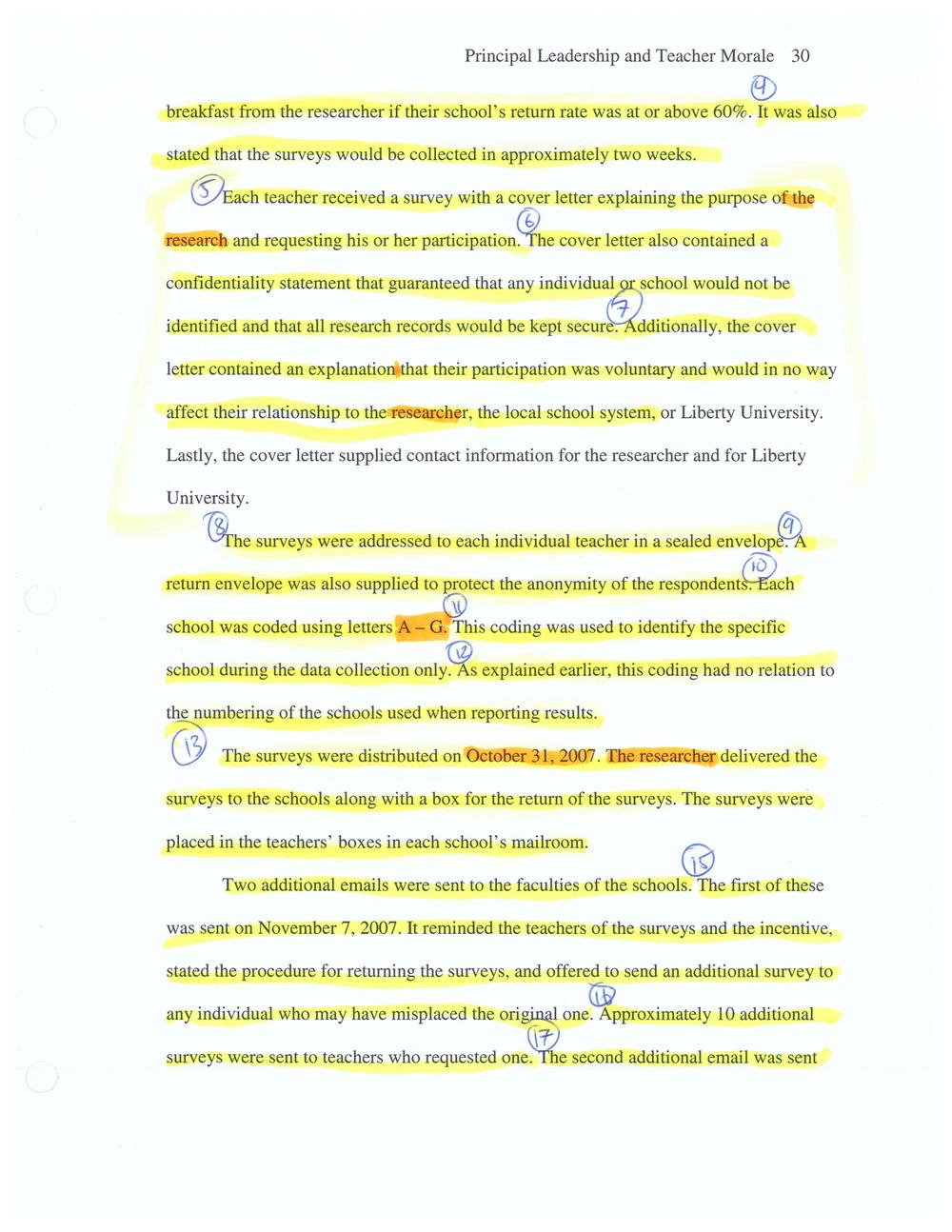
ROWLAND — Liberty, 2008, p.30 first
The surveys were addressed to each individual teacher in a sealedenvelops.Areturn envelope was also supplied to protect the anonymity of therespondent$-Eachschool was coded using letters- - G.This coding was used to identify the specific school during the data collection only.As explained earlier,this coding had no relation to the numbering of the schools used when reporting results
Hindt 2012, printed page 50 — the original scan.Rowland 2008, printed page 30 — published four years earlier.
Read the pages themselves
These are the worst-affected pages, printed as they appear in the dissertation.
Highlighted text is text that also appears in Rowland. Click any highlight to see his version.
Every page links to the original scan.
28
second area (i.e., Administrative Concern) is an area that deals with the teachers’ need to
teel appreciated and an administrator’s concurrent awareness of that need. Personal
Interaction is an area that encompasses the need for individuals to communicate and have
support from colleagues as well as administrators. When channels for effective
communication are open, the chance for high morale is more likely. Opportunity for
Input is an area of school operation that recognizes the teachers’ needs to be a part of
decisions that directly affect them. Finally, Professional Growth is the area that deals
with the teachers’ needs to continue their education or professional development. When
all these areas are in operation, high teacher morale is present.
Tye and O’Brien (2002) surveyed several teachers who had exited the profession.
Respondents gave the following range of reasons for dissatisfaction with teaching and for
changing professions: increased accountability, student attitudes, increased paperwork,
lack of parental support, unresponsive administration, low professional status, and low
salary. Hardy (1999) offered the following list as reasons that teachers choose to leave
the profession: low pay, poor professional status, negative interactions with students, and
poor relationships with administrators. Liu and Meyer (2005) list student discipline as the
number one factor Jeading to a low teacher morale and salary as the second factor.
Wentworth (1990) listed the following as the most influential factors affecting teacher
morale:
e Input into decision-making that directly affects curriculum,
instruction, and school climate;
Rowland 2008, page 14
teachers’ needs to continue their education or professional development.Tye and O’Brien (2002) surveyed several teachers who had
Rowland 2008, page 15
the profession: low pay, poor professional status,interactions with students, andrelationshipwithadministratorS7Liuand Meyer (2005) list student discipline as the number one factorleadingto a low teacher morale and salary as thenumber twofactor.;‘JWentworth (1990) listed the following as the
Rowland 2008, page 15
JWentworth (1990) listed the following as theessentialfactorsthat determineteacher morale:e nputinto decision-making that directly affects curriculum, instruction, and school climate.
e Recognition and appreciation of teacher and student
achievement;
e A school climate that reflects a feeling of unity, pride,
cooperation, acceptance of differences, and security;
e Good communication;
e Opportunities for meaningful professional growth;
e Clear, shared goals;
e Strong, supportive leadership;
e Quality time for collegial interaction: planning, educational
dialog, decision making, problem solving;
e Well-maintained physical environment;
e Good human relations, both within school and between school
and community;
e Encouragement and reward for risk taking, innovation, and
good teaching;
e Attention to professional needs such as salary, benefits, etc.;
and
e Attention to personal needs such as stress management, good
health, and social interaction.
Achievement
In addition to the research on teacher morale and the factors that influence it,
there is a body of research reports on the relationship of teacher morale to student
29
Rowland 2008, page 16
e Attention to personal needs such as stress management, good health, and social interaction. AchievementAnaddition to the research on teacher morale and the factors that influence
40
Thomas (1997) presented a meta-analysis focusing on leadership. leadership
theory and style, and the effect of principal leadership on teacher morale. The results
supported that ws leadership style of the building principal had a significant effect on
teacher morale. To be precise. a collaborative leadership style had the most positive
impact on teacher morale. In other words, schools with shared visions and decision-
making responsibilities were discovered to have higher teacher morale than schools
which allowed less teacher input into decision-making.
_/ inorder to determine which leadership style had the greatest impact on teacher
morale, Nguni, Sleegers, and Denessen (2006) examined two leadership styles,
transactional and transformational leadership. Transformational leadership traits, they
found, have a positive correlation to teacher morale. On the other hand, they found
transactional leadership traits to have the opposite correlation to teacher morale. As
mentioned before, transactional leadership offers motivation simply through rewards, for
instance, rewarding work with financial compensation. In contrast, transformational
leadership tends to provide the follower with more motivation as it enhances the
individual’s performance “beyond the exchange level to the level of self-actualization”
(Nguni, Sleegers, and Denessen, 2006).
: In contrast to some of the other findings, Evans and Johnson (1990) surveyed
middle and high school teachers and found inconsistent results. From their study, they
concluded that principal leadership had an overall effect on the stress level of teachers,
but they found the correlation between principal behaviors and teacher job satisfaction to
be insignificant. They also determined that a principal’s leadership has very little to do
Rowland 2008, page 18
onEvans and Johnson (1990) surveyed middle and high school teachers and foundconflictingresults.
42
e Give recognition to those who are helping to advance the
objectives of the school;
e Have written policy developed for procedures and
regulations;
e Exercise your authority;
e Provide resources needed to achieve the school’s
objectives; and
e Do your best to obtain competitive salary levels so you can
obtain the very best staff. (pg. 12)
“~~ Bhella (1982) conducted a study that correlated the Perdue Teacher Opinionaire
and The Principal Leadership Style Questionnaire. The results concluded that a
significant relationship exists between teacher/principal rapport and the principal’s level
of concern for people and production. The results indicated that an administrator who
exhibits a high level of concern for people also has a better rapport with the staff.
a“ - The final two studies submitted in this review enlist the use of two instruments
commonly present in research regarding principal leadership practices. In addition, the
instrumentation, method of data collection, and statistical methods of analysis of these
studies are quite similar as well. Each of these studies utilized the Perdue Teacher
Opinionaire, Which is a questionnaire to evaluate leadership. The second study also
included the use of the Leadership Practices Inventorv. In their study, Hunter-Boy kin and
Evans (1995) focused on the relationship between high school principals” leadership
practices and stvles with teacher morale using the Perdue Teacher Opinionaire. To collect
Rowland 2008, page 19
e Do your best to obtain competitive salary levels so you can obtain the very best staff.Bhella (1982)performeda study that correlated the Perdue Teacher Opinionaire and The Principal Leadership Style Questionnaire. Thestudy founda significant relationshipbetween teacher/principal rapport and the principal’s
43
the data. the Leadership Ability Evaluation instrument was used. The sample for the
study consisted of 40 high school principals and 411 high school teachers. The results of
the study demonstrated a low-positive correlation between the principal’s leadership style
and the teacher morale. It is important to note that the design of the study was such that
the principal’s leadership was self-reported rather than teacher-reported.
| The last study investigated the relationship between principal leadership. teacher
morale, and student achievement (Houchard, 2005). The instruments utilized were the
Perdue Teacher Opinionaire, the Leadership Practices Inventory. and the North Carolina
End-of-Course exams. The cross-secugy of this study consisted of teachers who
voluntarily submitted their responses. One hundred thirteen of the 124 teachers polled
responded to the Perdue Teacher Opinionaire and 115 responded to the Leadership
Practices Inventory. The sample population included eleven administrators who
responded to the Perdue Teacher Opinionaire, but no information on the number of
administrators who responded to the Leadership Practices Inventory is known. Several
significant relationships were evinced by the study. In the morale category. Rapport with
the Principal had a significant correlation to the leadership categorv of Enabling Others to
Act and Encouraging the Heart. Secondly. a significant correlation was found to exist
between the morale aspect of Satisfaction with Teaching with the leadership aspect of
Inspiring a Shared Vision and Enabling Others to Act. Another significant correlation
evidenced was that between the morale factor of Rapport with Teachers and the
leadership aspect of Enabling Others to Act and Encouraging the Heart. In addition. there
was also a significant correlation found between the morale factor of Teacher Load and
Rowland 2008, page 20
40 high school principals and 411 high school teachers. The results of the studyindicatealow positivecorrelation between the principal’s leadership style and
48
Expectations, Developmental Perspectives, Educational Attitudes, Faculty Fidelity,
Leadership Potential, and School Climate. Furthermore, each of these dimensions
encompass four dimensional index scales. For the purpose of this study, only one
dimension is utilized — specifically, the Leadership Potential. Within this dimension only
the following two dimensional index scales were researched: (a) The independent
variables of principal trust and (b) leadership satisfaction.
The dimension “Leadership Potential” was designed to relate teachers’
perceptions of their principals in two of the four dimensional index scales - principal trust
and leadership satisfaction. The validity of the instrument was based upon the design
purposes and specificity. Moreover, the MDed Survey was designed solely as a
comprehensive assessment tool to evaluate students, parents, and staff responses in order
to provide school districts with data to help every child reach his or her potential; to
assess leadership potential; and to assist school leaders by providing more accurate
information to help teachers reach their potential. The Multi-Dimensional Assessment
provides valuable data essential for identifying what changes are needed to improve
educational achievement and educator effectiveness. This is accomplished by focusing on
the seven dimensions and comprehensive index scales within each dimension. Principal
trust and leadership satisfaction are specific index scales that measure teacher morale as
related to the teachers’ perceptions of their principals’ leadership ability.
Permission to use the instrument was granted by the participating school district.
It is also important to point out that this instrument was carefully analyzed to ensure that
its age would not hinder its validity. Thus, the language used within this survey was made
Rowland 2008, page 26
It is also important to point out that this instrument was carefully analyzed to ensureits age would not hinder its validity.The language usedinthis survey wasconsistent with current educational language so that responses were not hindered by the age of the instrument. The
49
consistent with current educational language so that responses were not hindered by the
age of the instrument. The version of the survey used for this study was the 2009 survey
data completed by the teachers regarding their principal’s trust and leadership
satisfaction. The MDed Survey had content validity in that the questions were closely
aligned with the leadership characteristics they were designed to measure.
All teachers were assigned to receive the MDed Survey during the fall of the 2009
school year. The total return rate for the MDed survey for all three schools was 62%. A
total of 55 of the 89 teacher surveys were returned.
Permission to use this survey was obtained in writing from the authors
(see Appendix C). Also, permission was granted through the University of Houston,
Department of Research, to conduct this study under Category 4 of the research
application as exempt status (see Appendix D). In addition, permission was received from
the participating school district to research the archival MDed data for the purpose of this
study (see Appendix E).
Data Collection Procedures
At the direction of the superintendent, permission to perform the study was first
obtained from the three middle school principals. The Assistant Superintendent for
Middle Schools was then supplied with information in order to support the cost of the
survey at the district level. Once the superintendent’s signature was obtained, the
principals were contacted for faculty lists and to discuss the process for distributing the
surveys. A copy of the permission to perform research form is found in Appendix E.
Rowland 2008, page 27
The version of the survey used for this study was theobserver formcompleted by the teachers regarding their principal’sbehavior.Theinventoryhad content validity in that the questions were closelyrelated tothe leadership characteristics they were designed to measure
Rowland 2008, page 27
Permission to use this survey was obtained in writing from the authors (see Appendix
Rowland 2008, page 29
See Appendix D forasampleof the permission to perform research form.
50
After obtaining a list of each schools’ faculties, the assistant superintendent
provided the teacher lists to MDed. MDed provided each principal with enough surveys
for their teaching staffs and their student populations. Surveys were also sent to the
students’ guardian addresses as listed in the district’s student information system.
Teachers received an email from the principal describing the purpose of the
research prior to receiving the surveys. The email requested their participation and
offered an incentive for participation. The principals explained that their faculty would
receive a breakfast from the principal if their school’s return rate was at or above 60%. It
was also stated that the surveys would be collected in approximately two weeks.
o~ Fach teacher received a survey with a cover letter explaining the purpose of the
survey and a stated request for his or her participation. The cover letter also contained a
confidentiality statement which guaranteed that individuals would be kept anonymous
and that all research records would be kept securesAdditionally. the cover letter
contained an explanation stressing that their participation was voluntary and would in no
way affect their relationship to the local school system.
The surveys Were addressed to each individual teacher in a sealed envelopée: A
-
return envelope was also supplied to protect the anonymity of the respondents. Each
wv
school was coded using letters .\-C. This coding was used to identify the specific school
during the data collection only. This coding had no relation to the numbering of the
schools used when reporting results.
The surveys were distributed early in Max of 2009. Multi-Dimensional Education
Incorporated delivered the surveys to individual schools along with a box for the return of
Rowland 2008, page 30
Eachteacher received a survey with a cover letter explaining the purpose of theresearchandrequestinghis or her participation.
Rowland 2008, page 30
and that all research records would be keptsecure. Additionally,the cover letter contained an explanationthat their participation was voluntary and would in no way
Rowland 2008, page 30
The surveys were addressed to each individual teacher in a sealedenvelops.Areturn envelope was also supplied to protect the anonymity of therespondent$-Eachschool was coded using letters- - G.This coding was used to identify the specific school during the data collection only.As explained earlier,this coding had no relation to the numbering of the schools used when reporting results
51
the surveys. The surveys were then placed in the teachers” boxes in each school’s
mailroom.
Next, the principals sent two additional emails. The first email was sent to remind
the teachers of the surveys and the incentive, stating again the procedure for returning the
surveys and to offer to send_an additional survey to any individual who may have
misplaced the original one. Approximately 17 additional surveys were sent to teachers
Who requested one. The second additional email was sent stating that the collection of all
surveys Would occur within the last week of May. 2009>The email also thanked teachers
for their responses and informed them that they would be notified if their faculty had
earned a breakiast. And, upon the completion of the process, two of the three initiative
schools received the breakfast. The surveys were gathered by the assistant
superintendent and sent to Multi-Dimensional Education Incorporated during the first
week of June, 2009.
In August of 2009, the district received the results of the MDed survey. Survey
results were shared with the campus principals and staff. Additionally, the Assistant
Superintendent for Middle Schools summarized for the school systems Board of Trustees
during a regularly scheduled August Board meeting the comprehensive results for the
three 7-8 Initiative Middle Schools.
Data Analysis
Data organization. In an effort to compile the data, the participating school
district Assistant Superintendent for Middle Schools created a one-page summary sheet
to track the campus surveys. Each survey was then given a unique identification code to
Rowland 2008, page 30
the teachers of the surveys and the incentive,statedthe procedure for returning the surveys. andofferedto send an additional survey to any individual who may have misplaced the original one. Approximately10additional surveys were sent to teachers who requested one. The second additional email was sent
Every passage
Yellow is identical wording. Orange is the words that were
swapped — the sentence keeps its shape and only individual words change. Blue appears in
only one of the two.
Hindt p.7 · Rowland p.225 consecutive identical words
HINDT — Houston, 2012
The first chapter of this dissertation describes the background of the study, details the statement of the problem, discusses the professional significance of the study
ROWLAND — Liberty, 2008 first
The first chapter of this dissertation describes the background of the study, details the statement of the problem, discusses the professional significance of the study
Hindt p.12 · Rowland p.5proper name
HINDT — Houston, 2012
the principal preparation program in order to raiseteachermoraleand, thus, student achievement. Withthe demands on this growing school system to hire and retain teachers, this sort of principalpreparation program improvement couldprovevery beneficial. Overview Methodology To address the problem of the study and attempt to answer the research questions
ROWLAND — Liberty, 2008 first
the principal preparation program in order to raisethemoralelevel for teachersSWiththe demands on this growing school system to hire and retain teachers, this sort of principal—preparation program improvement couldbevery beneficial. Overview Methodology To address the problem of the study and attempt to answer the research questions
Hindt p.12 · Rowland p.529 consecutive identical words
HINDT — Houston, 2012
an in-depth look into this challenging level of education. Much of the present research focuses on elementary education, high school education, or a combination of levels of education
ROWLAND — Liberty, 2008 first
an in-depth look into this challenging level of education Much of the present research focuses on elementary education, high school education, or a combination of levels of education
Hindt p.12 · Rowland p.525 consecutive identical words
HINDT — Houston, 2012
Addition toits overallsignificanceand relevancefor the field,this researchis important to the school systemin whichthe study wasyaperformed.
ROWLAND — Liberty, 2008 first
o Inaddition tothesignificancefor the field,the studyis important to the school systemwherethe study wasperformed.
Hindt p.13 · Rowland p.7proper name
HINDT — Houston, 2012
turns to a detailed discussion of the methodology used inthestudy.ChapterFourpresents the results of the research as they relate to the
ROWLAND — Liberty, 2008 first
turns to a detailed discussion of the methodology used inthis study.Thefourthchapterpresents the results of the research as they relate to the
Hindt p.13 · Rowland p.7proper name
HINDT — Houston, 2012
Then,Chapter Threeturns to a detailed discussion of the methodology used inthestudy.
ROWLAND — Liberty, 2008 first
The third chapterthenturns to a detailed discussion of the methodology used inthisstudy.
Hindt p.15 · Rowland p.931 consecutive identical words
HINDT — Houston, 2012
Continuing research on effective schools has verified thecommon-senseobservation that schools are rarely effective, in any sense of the word. unless the principal is a‘good leader’”(p. 3
ROWLAND — Liberty, 2008 first
Continuing research on effective schools has verified thecommon senseobservation that schools are rarely effective, in any sense of the word, unless the principal is a“good” leader”(p. 3
Hindt p.15 · Rowland p.827 consecutive identical words
HINDT — Houston, 2012
century,“Therole of the principal was that of managerwhowas expected to uphold district mandates, manage personnel, manage the budget, and handle other operational issues
ROWLAND — Liberty, 2008 first
century,therole of the principal was that of managerwhere the principalwas expected to uphold district mandates, manage personnel, manage the budget, and handle other operational issues
Hindt p.19 · Rowland p.10citation year
HINDT — Houston, 2012
19Situational Leadership Lippitt (1969)asserted, ‘Leadershipmust be flexible in style to meet the need of a particularsituation”(p.
ROWLAND — Liberty, 2008 first
Situational Leadership Lippitt (1969)stated, “Leadershipmust be flexible in style to meet the need of a particularsituation...”(p.
Hindt p.19 · Rowland p.11proper name
HINDT — Houston, 2012
Goal Theory, Hersey and Blanchard’s Situational Leadership, and Leader-Member Exchange Theory
ROWLAND — Liberty, 2008 first
Goal Theory, Hersey and Blanchard’s Situational Leadership, and Leader-Member Exchange Theory
Hindt p.21 · Rowland p.12citation year
HINDT — Houston, 2012
involved indecision-making“Theoverriding element of successful leadership is to involve people in the process of leading” (Horan, 1999, p.21)-Most
ROWLAND — Liberty, 2008 first
involved indecision-making-“Theoverriding element of successful leadership is to involve people in the process of leading” (Horan, 1999, p.21). Most
Hindt p.21 · Rowland p.12proper name
HINDT — Houston, 2012
yLeader-Member Exchange Theoryis one thatfocusesprimarilyon the relationshipdeveloped betweenthe leader and follower.
ROWLAND — Liberty, 2008 first
TheLeader-Member Exchange Theoryfocusessolelyon the relationshipthe leader and followerdevelop.
Hindt p.22 · Rowland p.1333 consecutive identical words
HINDT — Houston, 2012
In order to do so,the leader mustbecome an expert onthe organization and its peopleso that he/she maydetermine the best course ofactionto lead the organizationtoward improvement.
ROWLAND — Liberty, 2008 first
The leader muststudythe organization and its peopletodetermine the best course ofimprovementto lead the organizationto become more.
Hindt p.22 · Rowland p.13proper name
HINDT — Houston, 2012
Model the Way (interactive), Inspire Shared Vision (visionary), Challenge the Process (creative), Enable Others Act (empowering), and Encourage the Heart (passionate
ROWLAND — Liberty, 2008 first
Model the Way (interactive), Inspire Shared Vision (visionary), Challenge the Process (creative), Enable Others Act (empowering), and Encourage the Heart (passionate
Hindt p.26 · Rowland p.14citation year
HINDT — Houston, 2012
Bentley and Rempel (1980),the authors of the Purdue Teacher Opinionaire, offer the following definition: “Morale refers to theprofessional interest and enthusiasm that a person displays toward the achievement of individual and group goals in a given job situation” (p.
ROWLAND — Liberty, 2008 first
Principal Leadership and Teacher Morale 14 Teacher Morale Teacher morale has been definedBentley and Rempel (1980)as “theprofessional interest and enthusiasm that a person displays toward the achievement of individual and group goals in a given job situation” (p.
Hindt p.26 · Rowland p.14citation year
HINDT — Houston, 2012
For instance, Wentworth (1990) stated, “Lowstaff morale results from professional lives that have little meaning; from frustration and the inability to change what is happening”
ROWLAND — Liberty, 2008 first
“Powstaff morale results from professional lives that have little meaning; from frustration and the inability to change what is happening”(Wentworth, 1990, p.
Hindt p.28 · Rowland p.15proper name
HINDT — Houston, 2012
into decision-making that directly affects curriculum, instruction, and school climate; Recognition and appreciation of teacher and student achievement; A school climate that reflects a feeling of unity, pride, cooperation, acceptance of differences, and security; Good communication; Opportunities for meaningful professional growth; Clear, shared goals; Strong, supportive leadership; Quality time for collegial interaction: planning, educational dialog,decisionmaking, problem solving; Well-maintained physical environment; Good human relations, both within school and between school and community; Encouragement and reward for risk taking, innovation, and good teaching; Attention to professional needs such as salary, benefits, etc
ROWLAND — Liberty, 2008 first
into decision-making that directly affects curriculum, instruction, and school climate. Recognition and appreciation of teacher and student achievement. A school climate that reflects a feeling of unity, pride, cooperation, acceptance of differences, and security. Good communication. Opportunities for meaningful professional growth. Clear, shared goals. Strong, supportive leadership. Quality time for collegial interaction: planning, educational dialog,decision-making, problem solving. Well-maintained physical environment. Good human relations, both within school and between school and community. Encouragement and reward for risk taking, innovation, and good teaching. Attention to professional needs such as salary, benefits, etc
Hindt p.28 · Rowland p.15citation year
HINDT — Houston, 2012
the profession: low pay, poor professional status,negativeinteractions with students, andpoor relationshipswithadministrators. Liuand Meyer (2005) list student discipline as the number one factorJeadingto a low teacher morale and salary as thesecondfactor.Wentworth (1990) listed the following as the
ROWLAND — Liberty, 2008 first
the profession: low pay, poor professional status,interactions with students, andrelationshipwithadministratorS7Liuand Meyer (2005) list student discipline as the number one factorleadingto a low teacher morale and salary as thenumber twofactor.;‘JWentworth (1990) listed the following as the
Hindt p.28 · Rowland p.14citation year
HINDT — Houston, 2012
teachers’ needs to continue their education or professional development.When all these areas are in operation, high teacher morale is present.Tye and O’Brien (2002) surveyed several teachers who had
ROWLAND — Liberty, 2008 first
teachers’ needs to continue their education or professional development.Tye and O’Brien (2002) surveyed several teachers who had
Hindt p.28 · Rowland p.15citation year
HINDT — Houston, 2012
Wentworth (1990) listed the following as themost influentialfactorsaffectingteacher morale:Inputinto decision-making that directly affects curriculum, instruction, and school climate;
ROWLAND — Liberty, 2008 first
JWentworth (1990) listed the following as theessentialfactorsthat determineteacher morale:e nputinto decision-making that directly affects curriculum, instruction, and school climate.
Hindt p.29 · Rowland p.16proper name
HINDT — Houston, 2012
e Attention to personal needs such as stress management, good health, and social interaction. AchievementInaddition to the research on teacher morale and the factors that influence
ROWLAND — Liberty, 2008 first
e Attention to personal needs such as stress management, good health, and social interaction. AchievementAnaddition to the research on teacher morale and the factors that influence
influence teacher efficacy:“modelingbehavior. inspiring group purpose. recognizing teacher efforts and accomplishments, providing personal and professional support, managing student behavior, and promotingSense of community
ROWLAND — Liberty, 2008 first
influence teacher efficacy:modelingbehavior. inspiring group purpose, recognizing teacher efforts and accomplishments, providing personal and professional support, managing student behavior, and promotingasense of community
Hindt p.39 · Rowland p.17proper name
HINDT — Houston, 2012
recognizing teacher efforts and accomplishments, providing personal and professional support, managing student behavior, and promotingSense ofcommunity” (Hipp).
ROWLAND — Liberty, 2008 first
inspiring group purpose,recognizing teacher efforts and accomplishments, providing personal and professional support, managing student behavior, and promotingasense ofcommunity.
Hindt p.40 · Rowland p.1827 consecutive identical words
HINDT — Houston, 2012
In other words,schools with sharedvisions and decision- making responsibilitieswerediscoveredto have higher teacher morale than schoolswhich allowedlessteacherinput into decision-making.
ROWLAND — Liberty, 2008 first
That 1s,schools with shareddecision-makingwerefoundto have higher teacher morale than schoolsallowinglessinput into decision-making.
Hindt p.40 · Rowland p.18citation year
HINDT — Houston, 2012
In contrast to some of the other findings,Evans and Johnson (1990) surveyed middle and high school teachers and foundinconsistentresults.
ROWLAND — Liberty, 2008 first
onEvans and Johnson (1990) surveyed middle and high school teachers and foundconflictingresults.
Hindt p.40 · Rowland p.18citation year
HINDT — Houston, 2012
Evans and Johnson (1990) surveyed middle and high school teachers and found
ROWLAND — Liberty, 2008 first
Evans and Johnson (1990) surveyed middle and high school teachers and found
Hindt p.41 · Rowland p.19proper name
HINDT — Houston, 2012
study, they developed the following list of administrativebehaviors, roles, andpractices thatensure and sustain highteacher morale: Be open and have good morale yourself; Communicate at many levels; Involve others in setting objectives, planning, and decision-making; Set planning priorities; Your job is to get things done, not to do them yourself; Know the values and needs of your community, your students, and your staff; Hold high expectations for staff, but recognize your responsibility
ROWLAND — Liberty, 2008 first
study, they developed the following list of administrativepractices thatmaintain positiveteacher morale: Be open and have good morale yourself. Communicate at many levels. Involve others in setting objectives, planning, and decision-making. Set planning priorities. Your job is to get things done, not to do them yourself. Know the values and needs of your community, your students, and your staff. Hold high expectations for staff, but recognize your responsibility
Hindt p.42 · Rowland p.19citation year
HINDT — Houston, 2012
e Do your best to obtain competitive salary levels so you can obtain the very best staff.(pg. 12)Bhella (1982)conducteda study that correlated the Perdue Teacher Opinionaire and The Principal Leadership Style Questionnaire. Theresults concluded thata significant relationshipexistsbetween teacher/principal rapport and the principal’s
ROWLAND — Liberty, 2008 first
e Do your best to obtain competitive salary levels so you can obtain the very best staff.Bhella (1982)performeda study that correlated the Perdue Teacher Opinionaire and The Principal Leadership Style Questionnaire. Thestudy founda significant relationshipbetween teacher/principal rapport and the principal’s
Hindt p.42 · Rowland p.19proper name
HINDT — Houston, 2012
e Give recognition to those who are helping to advance the objectives of the school; Have written policy developed for procedures and regulations; Exercise your authority; Provide resources needed to achieve the school’s objectives
ROWLAND — Liberty, 2008 first
e Give recognition to those who are helping to advance the objectives of the school. Have written policy developed for procedures and regulations. Exercise your authority. Provide resources needed to achieve the school’s objectives
Hindt p.42 · Rowland p.19citation year
HINDT — Houston, 2012
12)Bhella (1982)conducteda study that correlated the Perdue Teacher Opinionaire and The Principal Leadership Style Questionnaire.
ROWLAND — Liberty, 2008 first
Bhella (1982)performeda study that correlated the Perdue Teacher Opinionaire and The Principal Leadership Style Questionnaire.
Hindt p.43 · Rowland p.20citation year
HINDT — Houston, 2012
that the principal’s leadership was self-reported rather than teacher-reported. Thelaststudyinvestigatedthe relationship between principal leadership. teacher morale, and student achievement (Houchard, 2005). The instrumentsutilizedwere the Perdue Teacher Opinionaire, the Leadership Practices Inventory. and the North Carolina End
ROWLAND — Liberty, 2008 first
that the principal’s leadership was self-reported rather than teacher-reported. Thetinalstudyincluded in this review examinedthe relationship between principal leadership, teacher morale, and student achievement (Houchard, 2005). The instrumentsused in the studywere the Perdue Teacher Opinionaire, the Leadership Practices Inventory. and the North Carolina End
Hindt p.43 · Rowland p.21proper name
HINDT — Houston, 2012
a significant correlation was found to exist between themoraleaspect Satisfaction with Teachingwiththe leadership aspect Inspiring Shared Vision and Enabling Others Act.
ROWLAND — Liberty, 2008 first
Principal Leadership and TeacherMorale21aspect Satisfaction with Teachingandthe leadership aspect Inspiring Shared Vision and Enabling Others Act.
Hindt p.43 · Rowland p.20figure
HINDT — Houston, 2012
40 high school principals and 411 high school teachers. The results of the studydemonstratedalow-positivecorrelation between the principal’s leadership style and
ROWLAND — Liberty, 2008 first
40 high school principals and 411 high school teachers. The results of the studyindicatealow positivecorrelation between the principal’s leadership style and
Hindt p.43 · Rowland p.21figure
HINDT — Houston, 2012
between the morale factor Teacher Load and44the leadership factor Inspiring Shared Vision and Enabling Others Act
ROWLAND — Liberty, 2008 first
between the morale factor Teacher Load andthe leadership factor Inspiring Shared Vision and Enabling Others Act
Hindt p.43 · Rowland p.21proper name
HINDT — Houston, 2012
between the morale factor Rapport with Teachers and the leadership aspect Enabling Others Act and Encouraging the Heart
ROWLAND — Liberty, 2008 first
between the morale factor Rapport with Teachers and the leadership aspect Enabling Others Act and Encouraging the Heart
Hindt p.43 · Rowland p.21proper name
HINDT — Houston, 2012
Rapport with the Principal hada significant correlationtothe leadershipcategorvEnabling Others Act and Encouraging the Heart.
ROWLAND — Liberty, 2008 first
a significant correlationwas shown between the morale factor Rapport with Teachers andthe leadershipaspectEnabling Others Act and Encouraging the Heart.
Hindt p.43 · Rowland p.21proper name
HINDT — Houston, 2012
the leadership aspect Inspiring Shared Vision and Enabling Others Act
ROWLAND — Liberty, 2008 first
the leadership aspect Inspiring Shared Vision and Enabling Others Act
Hindt p.43 · Rowland p.20proper name
HINDT — Houston, 2012
on the number of administrators who responded to the Leadership Practices Inventory
ROWLAND — Liberty, 2008 first
on the number of administrators who responded to the Leadership Practices Inventory
Hindt p.43 · Rowland p.20proper name
HINDT — Houston, 2012
the leadership aspect Enabling Others Act and Encouraging the Heart
ROWLAND — Liberty, 2008 first
the leadership aspect Enabling Others Act and Encouraging the Heart
Hindt p.44 · Rowland p.21proper name
HINDT — Houston, 2012
and the leadership aspect Inspiring Shared Vision and Enabling Others Act. This review of the
ROWLAND — Liberty, 2008 first
and the leadership aspect Inspiring Shared Vision and Enabling Others Act. This review of the
Hindt p.44 · Rowland p.21proper name
HINDT — Houston, 2012
and the leadership aspect Inspiring Shared Vision and Enabling Others Act
ROWLAND — Liberty, 2008 first
and the leadership aspect Inspiring Shared Vision and Enabling Others Act
Hindt p.44 · Rowland p.21figure
HINDT — Houston, 2012
44the leadership factor Inspiring Shared Vision and Enabling Others Act.
ROWLAND — Liberty, 2008 first
Next, there was a significant correlation between the morale factor Teacher Load andthe leadership factor Inspiring Shared Vision and Enabling Others Act.
Hindt p.45 · Rowland p.2226 consecutive identical words
HINDT — Houston, 2012
of the context of the study. the participants. the instruments, and the methods used in gathering the data. The chapter concludes with an explanation of the
ROWLAND — Liberty, 2008 first
of the context of the study, the participants, the instruments, and the methods used in gathering the data. The chapter concludes with an explanation of the
Hindt p.47 · Rowland p.24figure
HINDT — Houston, 2012
Subjects The population of the proposed studyincludedall middle school teachersat the three identified middle school campusesin this school system. The faculties of thesethreeschools contained a combined89teachers.thesampleproposedfor thisstudy consisted of all respondents from these
ROWLAND — Liberty, 2008 first
Subjects The population of the proposed studywasall middle school teachersin this school system. The faculties of thesesevenschools contained a combined471teachers.“The sample fortheproposedstudy consisted of all respondents from these
Hindt p.48 · Rowland p.26figure
HINDT — Houston, 2012
It is also important to point out that this instrument was carefully analyzed to ensurethatits age would not hinder its validity.Thus,the language usedwithinthis survey wasmade 49consistent with current educational language so that responses were not hindered by the age of the instrument. The
ROWLAND — Liberty, 2008 first
It is also important to point out that this instrument was carefully analyzed to ensureits age would not hinder its validity.The language usedinthis survey wasconsistent with current educational language so that responses were not hindered by the age of the instrument. The
Hindt p.49 · Rowland p.27citation year
HINDT — Houston, 2012
The version of the survey used for this study was the2009 survey datacompleted by the teachers regarding their principal’strust and leadership satisfaction.TheMDed Surveyhad content validity in that the questions were closelyaligned withthe leadership characteristics they were designed to measure
ROWLAND — Liberty, 2008 first
The version of the survey used for this study was theobserver formcompleted by the teachers regarding their principal’sbehavior.Theinventoryhad content validity in that the questions were closelyrelated tothe leadership characteristics they were designed to measure
Hindt p.49 · Rowland p.2931 consecutive identical words
HINDT — Houston, 2012
the superintendent’s signature was obtained, the principals were contacted for faculty lists and to discuss the process for distributing the surveys.Acopyof the permission to perform research form
ROWLAND — Liberty, 2008 first
the superintendent’s signature was obtained, the principals were contacted for faculty lists and to discuss the process for distributing the surveys.See Appendix D forasampleof the permission to perform research form
Hindt p.49 · Rowland p.29proper name
HINDT — Houston, 2012
permission to perform the study was first obtained fromthethree middle schoolprincipals. TheAssistantSuperintendentfor Middle Schoolswas then supplied with information in order to
ROWLAND — Liberty, 2008 first
Permission to perform the study was first obtained fromeach oftheprincipals. Theassociatesuperintendentwas then supplied with information in order to
Hindt p.49 · Rowland p.26figure
HINDT — Houston, 2012
49consistent with current educational language so that responses were not hindered by the age of the instrument.
ROWLAND — Liberty, 2008 first
The language used in this survey wasconsistent with current educational language so that responses were not hindered by the age of the instrument.
Hindt p.49 · Rowland p.27proper name
HINDT — Houston, 2012
Permission to use this survey was obtained in writing from the authors (see Appendix
ROWLAND — Liberty, 2008 first
Permission to use this survey was obtained in writing from the authors (see Appendix
Hindt p.49 · Rowland p.27proper name
HINDT — Houston, 2012
Permission to use this survey was obtained in writing from the authors (see AppendixC).
ROWLAND — Liberty, 2008 first
Permission to use this survey was obtained in writing from the authors (see AppendixB).
Hindt p.49 · Rowland p.29proper name
HINDT — Houston, 2012
Acopyof the permission to perform research formis found Appendix E.
ROWLAND — Liberty, 2008 first
See Appendix D forasampleof the permission to perform research form.
Hindt p.50 · Rowland p.30proper name
HINDT — Houston, 2012
The surveys Were addressed to each individual teacher in a sealedenvelopée:A-return envelope was also supplied to protect the anonymity of therespondents. Each wvschool was coded using letters.-C.This coding was used to identify the specific school during the data collection only.This coding had no relation to the numbering of the schools used when reporting results
ROWLAND — Liberty, 2008 first
The surveys were addressed to each individual teacher in a sealedenvelops.Areturn envelope was also supplied to protect the anonymity of therespondent$-Eachschool was coded using letters- - G.This coding was used to identify the specific school during the data collection only.As explained earlier,this coding had no relation to the numbering of the schools used when reporting results
Hindt p.50 · Rowland p.30figure
HINDT — Houston, 2012
return rate was at or above 60%. It was also stated that the surveys would be collected in approximately two weeks.o Fachteacher received a survey with a cover letter explaining the purpose of thesurveyanda stated request forhis or her participation. The cover letter also contained a
ROWLAND — Liberty, 2008 first
return rate was at or above 60%. It was also stated that the surveys would be collected in approximately two weeks.Eachteacher received a survey with a cover letter explaining the purpose of theresearchandrequestinghis or her participation. The cover letter also contained a
Hindt p.50 · Rowland p.2931 consecutive identical words
HINDT — Houston, 2012
describing the purpose of the research prior to receiving the surveys. The email requested their participation and offered an incentive for participation.The principalsexplained that their faculty would receive a
ROWLAND — Liberty, 2008 first
describing the purpose of the research prior to receiving the surveys: The email requested their participation and offered an incentive for participation.It wasexplained that their faculty would receive a
Hindt p.50 · Rowland p.3026 consecutive identical words
HINDT — Houston, 2012
and that all research records would be keptsecuresAdditionally.the cover letter contained an explanationstressingthat their participation was voluntary and would in no way
ROWLAND — Liberty, 2008 first
and that all research records would be keptsecure. Additionally,the cover letter contained an explanationthat their participation was voluntary and would in no way
Hindt p.50 · Rowland p.30figure
HINDT — Houston, 2012
schools along with a box for the return of51the surveys. The surveys werethenplaced in theteachers”boxes in each school’s mailroom
ROWLAND — Liberty, 2008 first
schools along with a box for the return ofthe surveys. The surveys wereplaced in theteachers’boxes in each school’s mailroom
Hindt p.50 · Rowland p.30proper name
HINDT — Houston, 2012
o Fachteacher received a survey with a cover letter explaining the purpose of thesurveyanda stated request forhis or her participation.
ROWLAND — Liberty, 2008 first
Eachteacher received a survey with a cover letter explaining the purpose of theresearchandrequestinghis or her participation.
Hindt p.51 · Rowland p.30figure
HINDT — Houston, 2012
the teachers of the surveys and the incentive,stating againthe procedure for returning the surveys andto offerto send an additional survey to any individual who may have misplaced the original one. Approximately17additional surveys were sent to teachers Who requested one. The second additional email was sent
ROWLAND — Liberty, 2008 first
the teachers of the surveys and the incentive,statedthe procedure for returning the surveys. andofferedto send an additional survey to any individual who may have misplaced the original one. Approximately10additional surveys were sent to teachers who requested one. The second additional email was sent
Hindt p.51 · Rowland p.31figure
HINDT — Houston, 2012
created a one-page summary sheet totrack the campus surveys.Each survey was then given a unique identification code to52pair it withthe trackingsheetand home campusto allow easy matching in the event of a discrepancy. The
ROWLAND — Liberty, 2008 first
created a one-page summary sheet toscore each respondent’s survey.Each survey was then given a unique identification code topair it witha scoringsheetto allow easy matching in the event of a discrepancy. The
Hindt p.51 · Rowland p.31citation year
HINDT — Houston, 2012
that the collection of all surveys Would occurwithinthelast week May. 2009>The email also thankedteachers for their responses and informed them that they would be notified if their faculty had earned a
ROWLAND — Liberty, 2008 first
that the collection of all surveys would occurNovember 16, 2007. It thankedtheteachers for their responses and informed them that they would be notified if their faculty had earned a
Hindt p.52 · Rowland p.32figure
HINDT — Houston, 2012
Summary Methodology This chapter described and explained the methods used in this study. It stated the type of research and described the context for the research. A description of the53participants of the study was given along with a description ofthe survey.The procedures were fully discussed then the data analysis explained
ROWLAND — Liberty, 2008 first
Summary Methodology This chapter described and explained the methods used in this study. It stated the type of research and described the context for the research. A description of theparticipants of the study was given along with a description ofboth surveys.The procedures were fully discussed then the data analysis explained
Hindt p.52 · Rowland p.32proper name
HINDT — Houston, 2012
Summary Methodology This chapter described and explained the methods used in this study.
ROWLAND — Liberty, 2008 first
Summary Methodology This chapter described and explained the methods used in this study.